Yesterday afternoon was fine, if a bit misty, but there was no wind as such so I thought it would be a good time to pop down to SWT Castle marshes at North Cove to try and photograph the Barn Owls that have been frequenting the area recently. I walked along the river wall for a little way but saw no sign of any owls but spent some time watching a herd of Highland cattle on a marsh which included a few calves that looked very cute. Returning to the area that I knew an owl had been roosting recently I sat on the wall and waited hoping for an owl to appear but after 15 minutes or so a small movement in my peripheral vision caused me to slowly turn and I saw an Otter moving along the reeds on the far bank. Carefully positioning myself behind the camera I spotted 2 other otters and realised it was a female with her 2 well grown cubs.
Recently there have been reports of a female with 2 cubs upstream as far as Beccles Sailing club so it is likely that these were the same animals as they roam over a large territory. The cubs were playing in amongst the reeds as they slowly made their way upstream but I managed a few shots in the rapidly disappearing light. I did try to follow them to take more pictures but they became aware of me and disappeared under the water so I left the river to them and returned to the car. I never did see an owl but a few plops from the dykes as I walked along could indicate the presence of Water voles so that might be worth further investigation in the future.
On Monday I made a reasonably early start at RSPB Minsmere and walked straight down to Island mere hide passing several Green Woodpeckers and a couple of Muntjac deer on the way where I found one other person who had beaten me to the hide by about 5 minutes. Immediately to the right of the hide a Little Egret was perched on an area of cut reed bed allowing good views and it remained around the hide for the majority of the time I was there. A few Teal and some noisy geese surrounded the hide while out on the mere both Little Grebe and Great crested Grebe could be seen along with the Mute Swans, Coots and Mallards. After a while a family group of Otters appeared along the left edge of the mere comprising a female and 2 cubs but they did not linger and soon departed from view on the far side of the water.
Marsh Harriers were constantly in the air and some of the males were showing signs of building nests while all around the sound of squealing Water Rails could be regularly heard along with the occasional Bittern booming and Cetti's Warbler calling. Out in front of the hide 2 Snipe became active and began to feed allowing a few shots of them in the clear unobstructed from view by the cut reed stems for a change. At about 9.30 am I got lucky as I happened to spot a male (dog) otter I think who hopped out onto the bank for all of 2 seconds before diving back in the water; anyway it was enough time for me to grab a shot before he disappeared.
Leaving Minsmere I decided to pop up to Sizewell as I was so close and walking along in front of the power station I spotted someone with a camera taking pictures of what turned out to be a Black Redstart. Its only been the last week or so that these birds have started to return to their breeding grounds and usually a few birds can be seen in this area around the power stations. The bird was a male and it had obviously just had a bath as its feathers were still soaking and it was perched in the sun drying off so the pictures are not great but I will try to return soon and get some better shots.
Hearing reports of really good views of Short eared owls from Halvergate marshes I made my way there last week full of optimism, however on arrival it became obvious that the strong wind was going to discourage the owls from hunting. Speaking to 2 other photographers who had been there since dawn it became apparent that I should have got up earlier as they had some super shots of hunting owls taken at first light before the wind got up. I did get to see one owl briefly flying but before I could swing the camera around it had gone down in some longer grass and in the 2 hours that I was there it did not fly again; it could have been because it was too windy but on the other hand it might have been that the owl had caught something and was digesting its meal.
Throughout my time looking over the marshes I had distant views of both Common Buzzards and a wintering Rough legged Buzzard but neither approached too closely. There were also several Kestrels hunting near the railway line and Marsh Harriers regularly flew across keeping me interested. Eventually I spotted a Marsh Harrier approaching me flying into the wind and it kept coming closer, ignoring me standing in front of my car, hunting over the marsh in the sunshine allowing me to get some reasonable shots. Its amazing to think that 30 years ago these magnificent birds were incredibly rare but now, especially around here they are so common that we take them for granted but even so its not often that I get close enough to get pictures of them that I think are OK.
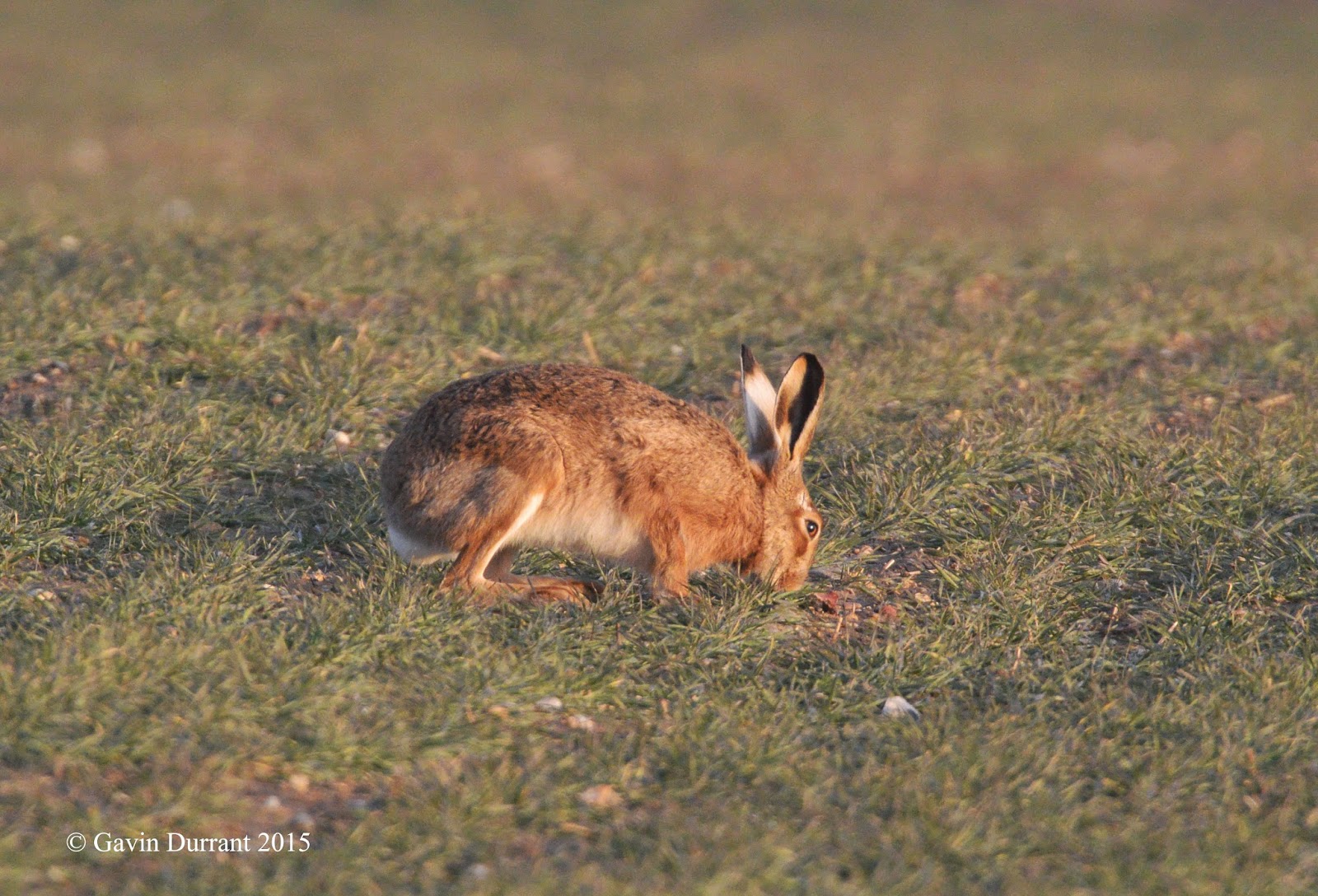
Last week I spent a day sitting in a semi dry ditch in the hope that one of the many Hares in a field would approach near enough to picture or at least partake in some 'mad march ' behaviour but unfortunately the weather had other ideas and the keen north -easterly wind meant that the hares decided to keep their heads down and they hardly ventured from their scrapes. Wrapped up in thermals with a flask of hot coffee I was comfortable enough but had to settle for distant views of Buzzards and Marsh Harriers and began to think that the day would be a waste when a Chinese Water Deer appeared at the far end of the field.
Slowly the deer made its way across the field towards me in the ditch and as I was downwind it did not detect my presence and got closer and closer. I snapped away with the camera until it was only about 30 feet from me before it suspected something was amiss and paused at which point I froze, keeping my face behind the camera and hardly daring to breathe. It seemed ages but was only probably about 30 seconds before the deer slowly walked around me and made its way towards some nearby trees and I was able to move again. These animals are usually very wary around humans and I don't often get such close encounters with them, lucky me!
Last week on a cold and misty morning I trudged along the shingle past the Dunwich shore pools up to the area where people have been putting down seed for the flocks of Snow Bunting and Twite that have been frequenting the beach. As I said it was very cold and apart from a few dog walkers near to the car park I had the whole length of the coast to myself and as I walked along I observed lots of gulls, a few Skylarks and Stonechats, a group of Ringed plover, a small group of Brent geese and various waders on the shore pools. Reaching the feeding site a large group of about 40 Snow Buntings took off and moved a 100 yards down the beach so I lay down on the shingle and waited.
It didn't take long for the flock to return, flying into the strong breeze and landing on and around the feeding site, staying for a few minutes before flying off to another area further down. This set the pattern for the next hour or so as they repeatedly flew in, fed and then flew off again. The strong wind allowed me to get some flight shots of the birds as they came in to land and hovered slightly before touching down. It was a mixed flock of male and female birds many of which were ringed and I could see that some of the male birds were becoming much brighter which is caused by the brown colouration on the ends of their feathers wearing off revealing the black and white breeding plumage beneath.
After the prolonged period of laying on the shingle the cold began to permeate through my layers of clothing despite the regular cups of hot coffee so I left the flock to their foraging realizing that they would soon be departing for their breeding grounds in Scandinavia as the weather warmed up and I may not see them again until next autumn. Heading back along the beach towards the car park I came across the group of Ringed Plover again as they relocated onto one of the shore pools so I sat down a little out of the wind and watched them. A couple of the birds were quite tolerant of my presence and as I sat still they approached closely allowing me to photograph them at will but after a while I decided that I had to head back to the car to warm up. All in all a super few hours without hardly seeing another person in the company of some beautiful little birds.
Last week I had the chance to spend a few hours in the sunshine at a new location for me looking for Hares. On arrival and scanning the fields with binoculars I could see one or two hares laying down in a crop of winter wheat but as the afternoon progressed and the light levels lowered I began to realize that there were a lot more than one or two animals present, in fact as they became more active and started to move around at one point I counted 21 hares in view at the same time. I knew that the farmer who owned the land did not shoot these animals but I was amazed by the number I could see.
I watched the hares until the light levels became too low for photography in the hope of seeing some 'boxing' but they seemed more interested in grooming and foraging and generally all seemed to get on together remarkably well. I will have to try and spent some time here over the next few weeks to hopefully catch some more interesting behaviour.
For the last couple of weeks some unusual visitors have been spotted in the river at Beccles Quay, a pair of Scaup who have been occasionally accompanied by a third bird. The Scaup is a predominately sea going duck only rarely seen inland and usually at distance but the two birds at Beccles are certainly disproving this description regularly coming within 20 yards of the bank giving very good views. Both birds appear to be female or immature examples which can be seen by the mainly brown plumage with white face patches which are more obvious in one of the pair. Adult males are much more distinctive having a black/green head and neck with a white and grey body.
These duck nest in Iceland, Scandinavia and northern Russia on the ground near to water and feed mainly on shellfish such as mussels but they will also take plant matter too which they get by diving. In the winter the birds migrate to the coasts of north west Europe where they may remain until March although some immature birds stay on their wintering grounds all year. Countless observers have been amazed by how confiding the Beccles birds have been and as of today they are still around the quay area.


.jpg)


.jpg)
.jpg)
.jpg)
.jpg)
.jpg)
.jpg)


.jpg)