Monday, April 21, 2014

SPRING FLOWERS AND INSECTS ALONG THE WAVENEY

   Last weekend I spent an enjoyable day walking along the river from Beccles to North Cove and then through some of the woodland in the valley. The spring flowers were really starting to show well and butterflies and other insects were flying between the colourful heads seeking nectar. The first to be seen were the Marsh Marigolds with their bright yellow flowers which were attracting many bees and hoverflies. A few white butterflies were seen most of which were Small Whites but upon closer examination some of them were Green Veined Whites which would sometimes come to rest on the vegetation as shown below.

   Walking away from the river into more wooded areas I encountered a few Bluebells in the shade of the branches and fluttering in a clearing were the first Orange Tip butterflies of the year for me, the first below on a Garlic Mustard flower and the second on a Bluebell which really made a good picture with the mixture of colours. Both of these butterflies were males as they are the only ones with orange on the wings, the females being white with a black spot and tip to the forewing.

   Driving along to Aldeby I came across a patch of Cowslip (primula veris) on the road side and so stopped to take a few pictures. There were also some patches of common Primrose (primula vulgaris) but being in the full sunshine these were past their best.

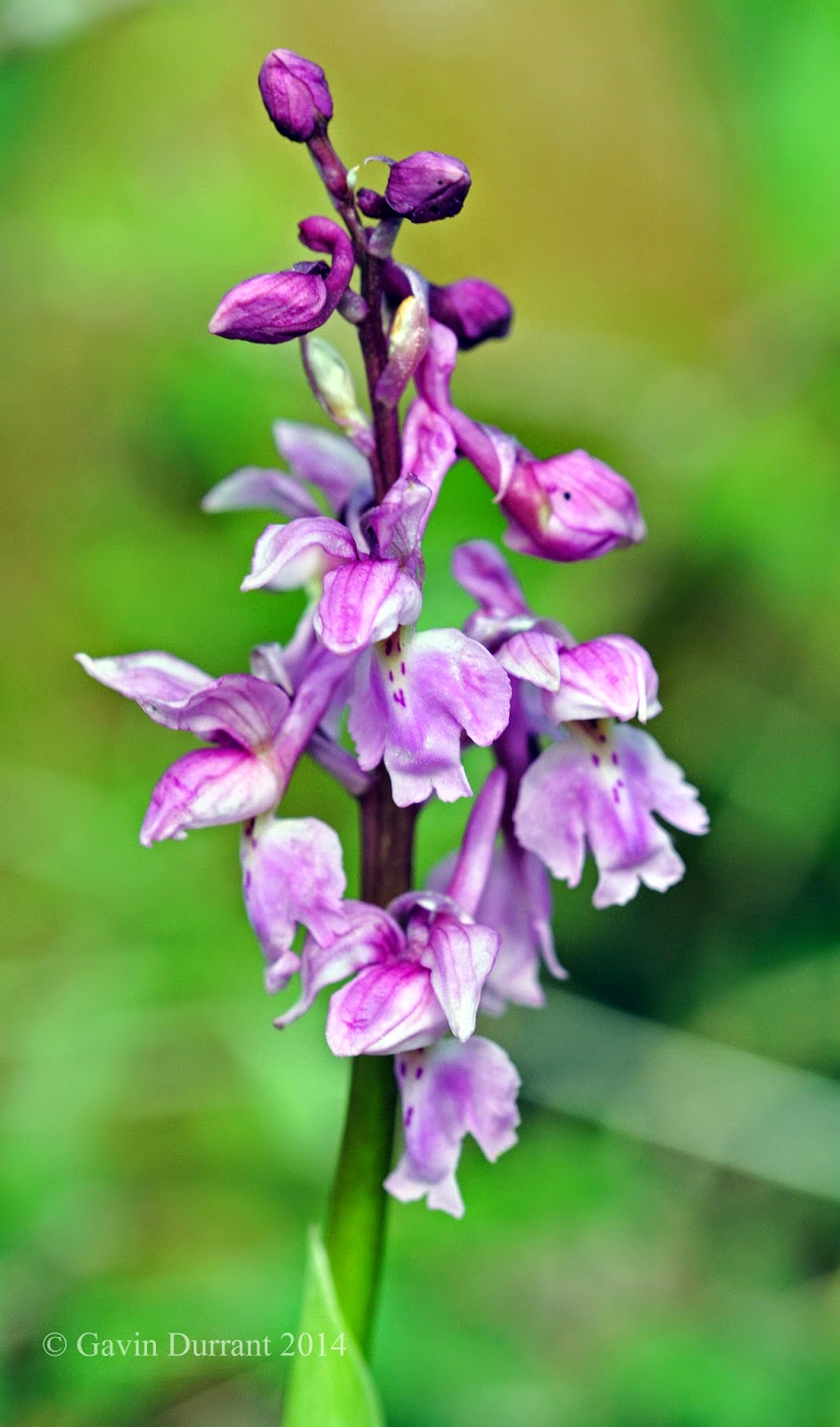
   Parking the car I walked into a small woodland where I have seen orchids in flower before and began to search through the undergrowth coming across a few remaining Wood Anenomes at the end of their flowering season with their gorgeous yellow centered white flowers striking amongst the new seasons green growth. Eventually I came to a patch of Early Purple Orchids but very few were in flower and they need another week or so to reach their best but I took a picture of one that seemed to be ahead of the rest.


Sunday, April 6, 2014

ANOTHER DAY WITH THE ADDERS

   Waking up to a bright sunny day I decided to risk the weekend crowds and try to get some more Adder images before they disperse for the summer at Minsmere. There were quite a few people looking for them, some with more success than others but if you looked in the Bramble patches and were very quiet then they were there to be found. A brief look around revealed several snakes warming themselves up in the sun three of which are shown below, firstly a male, then a close up of a female, and then a darker form Adder.

   All together I saw about a dozen different snakes and observed some interaction between them. The males were still interested in the females and were competing with each other for their attention. Often a male would detect the presence of another and I saw them raising their heads up and scenting the air with their tongues before engaging in some brief combative 'dancing' with intruding males as can be seen in the two images below.

   This behaviour always resulted when a female was in the vicinity and the males were competing for the chance to mate. I was fortunate to witness one male drive off two separate intruders before mating with the female which he initiated by repeatedly tapping the female with small jerky movements before she accepted him and they joined together. The below pictures show a close up of the two heads together, the two joined, and a close up of the joining. This is something I had not seen before and I am told it is quite unusual to record. The pair remained joined for about an hour before separating and moving on.

   As the heat of the day warmed up the snakes they became more active and more difficult to see as they moved around more disappearing in the undergrowth but this did give me the chance to picture them out in the open as shown in these last three images, firstly a male close up, then a female on the leaf litter giving me the eye and finally a male coming towards me through the grass as I lay on the ground and yes, I did move out of the way before he got too close! A great day with some beautiful creatures.


Tuesday, April 1, 2014

REPTILES ON A MINSMERE MONDAY

   Decided to avoid the weekend crowds and try to see the Adders that have been showing very well for the last few weeks at the reserve but typically for me the warm sunshine of recent days had given way to cloudy skies but as it was still quite warm I persevered and I was glad I did. A walk past the normal haunt of these snakes revealed nothing so I carried on to Island mere hide which resulted in distant Bittern sightings and fleeting glimpses of a Jack Snipe along with the usual collection of ducks,geese and grebes. As the temperature rose and the sun tried to break through I strolled back along the path and amongst a pile of wood and scrub recently cleared sudden movement caught my eye which turned out to be a Common Lizard that on closer examination was revealed to be a female. Initially perched on a log the lizard moved through the pile allowing brief opportunities to take pictures of which a couple can be seen below.

   As I walked along I was continually looking into patches of Brambles and the dead leaves that coated the ground and eventually was rewarded with the sight of a female Adder basking in a small gap in a tangle of undergrowth. I approached slowly and upon closer inspection realised that another Adder was also there, darker in colouration with a cloudy blue eye which indicated that it was soon about to shed its skin. The two snakes slowly moved closer to each other giving me the chance to take a variety of images including a few closer shots before I moved away to leave them undisturbed.

   Adders emerge from hibernation in March to breed when the generally smaller males will compete with each other to mate with the females. The males are often lighter in colour being either grey or almost white with dark zig zag patterns whereas the females are normally brown also with the same patterns. Sometimes at this time of the year you can see two males intertwined trying to push each other to the ground and this is known as 'dancing' and is spectacular to see. The larger snake normally wins and gets the chance to mate with the female. The female then normally moves some distance away to give birth to live young, sometimes as far as a kilometre or so in August but as the temperature drops they return to their traditional hibernating sites for the winter. On Monday I was not fortunate enough to see any males displaying but this may have been due to the lack of sunshine as they have been seen regularly in recent days. Oh well, maybe next time!


MOTHERS DAY BEE-FLIES

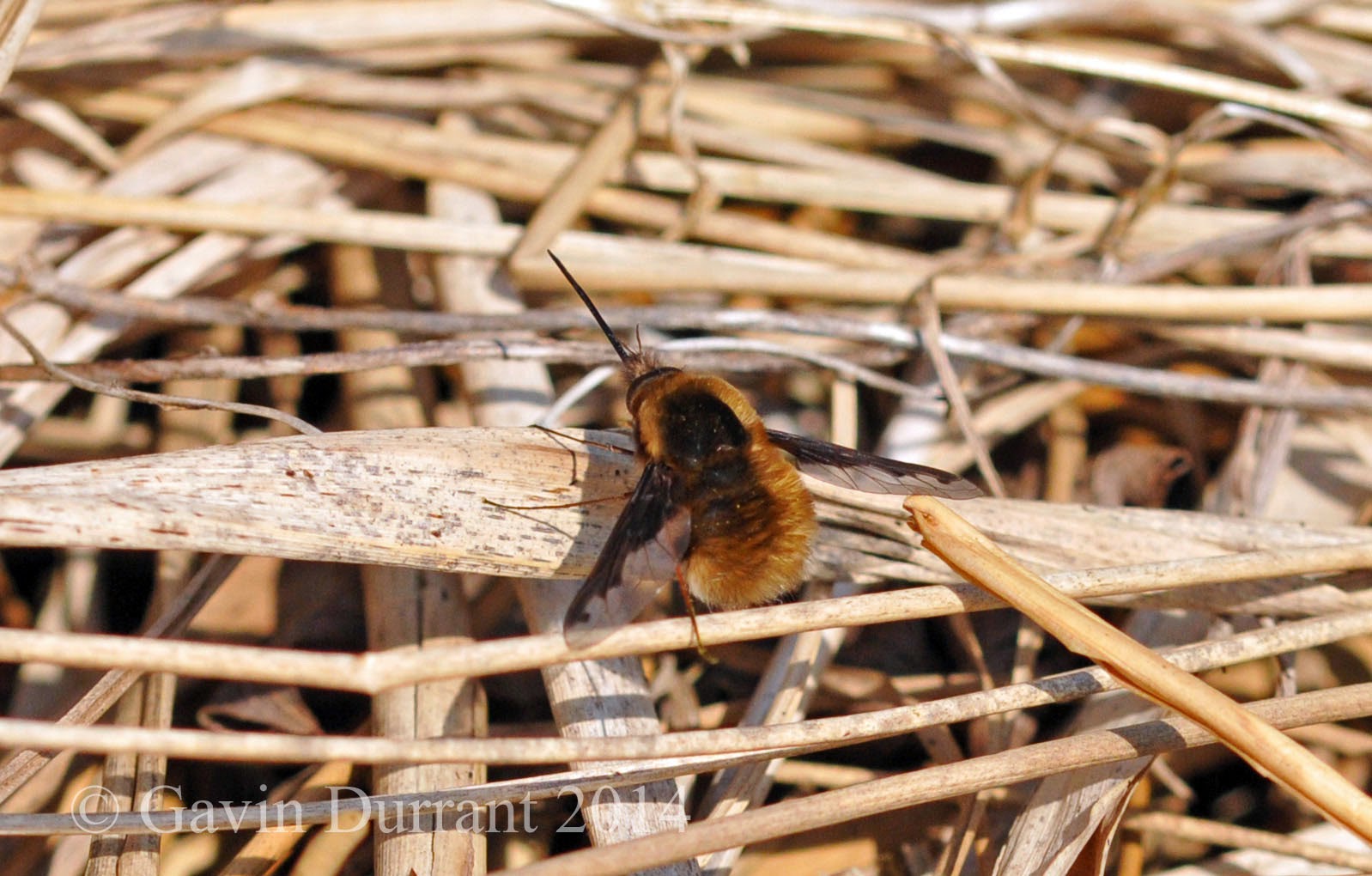
   Glad I took my camera when we visited mother in law on Sunday as a stroll around the garden revealed several Bee-flies hanging around the flower borders and with a bit of patience managed to get a few better images for the blog. The Bee-fly is very distinctive with its furry body and rigid proboscis but despite its appearance it is totally harmless and is often seen in gardens feeding on the flowers. It is seen between March and June and its larvae live as parasites in the nests of ground burrowing bees. I can't remember the name of the flowers they were feeding on but they are abundant in the garden at the moment.


Saturday, March 29, 2014

A WEEKS WORTH OF PICTURES

   With my long lens out of action at the moment this week I've concentrated on smaller subjects starting with my garden where the frogs have been active and the spawn has started to appear. Below are a couple of pictures of one of the frogs having a rest in the weed keeping its eyes on me.

   Moving on to SWT North cove reserve today a variety of beetles were seen along with many butterflies including Peacocks, Small Tortoishell, Comma and Brimstone. Also in evidence were an abundance of bees and the first Bee-flies of the year but no sign of any snakes as yet. Pictured below is first, a Bloody -nosed beetle (Timarcha tenebricosa), secondly an Oieceoptoma thoraccicum beetle which is very distinctive with its orange head and then a heavily cropped photo of a Bee-fly. The Bloody nosed beetle is a very large flightless insect so called because of its ability to ooze blood from its mouth when threatened which is usually enough to deter predators.

   Finally for this post a picture of a drake Pintail taken at a farm pond in Aldeby in South Norfolk in the warm afternoon sunlight.


Saturday, March 15, 2014

SPRING IN THE GARDEN

   A quick look around the garden this afternoon revealed that spring is well and truly on the way, the Cherry tree is in full flower and several bees were taking advantage of the warm conditions looking for a pollen feed. The most numerous were the Honey bees as seen above but there were also one or two Bumble bees which I think are Tree Bumblebees (Bombus hypnorum). I managed to get a shot of the bee flying as well as feeding on the Cherry, see below.

   Also seen in the garden was the first white butterfly of the year for me which is a Small White butterfly that was perched on a Tulip flower. They are very common but I don't get to see many of them this time of the year and I believe that this particular example is a male.


Saturday, March 8, 2014

WHOOPER SWANS AT LAST

   Finally some settled weather saw me visit Minsmere once again primarily to see the Smew that have been resident there for the last few weeks but once again although the birds were visible they did not approach close enough for any good pictures. There is quite a bit of work going on at the reserve at the moment which may be related to BBC Springwatch being broadcast from here this season although this is yet to be confirmed but if this is the case things are going to get very busy in the coming weeks. Anyway back to my visit and though the ducks were being uncooperative the same could not be said for a pair of Whooper swans who in the late afternoon appeared in one of the pools behind the South hide coming quite close in the shade of some reeds. Soon these birds will be off back north to summer and breed in Iceland so I was glad to see them before they departed which could be any time soon with the warmer weather conditions.

   After the swan encounter I made my way down to Island mere hide to hopefully watch the Starling murmuration that has been reliable for the last week or two. As dusk approached more and more people turned up in the hide to see the spectacle and eventually we saw small flocks of Starlings arrive from various directions before joining together flying over the reedbeds. Increasing numbers constantly merged with the main flock in the evening light stretching across the sky and just as the light was failing the flock compressed into a tight ball of an estimated 30-40,000 birds before diving into the reeds to roost. Although I have seen this sight before it never fails to impress and I am already looking forward to the next one.